
We're turning the world’s most misunderstood waste into a renewable resource. Nuclear "waste" remains one of the biggest hurdles to public acceptance of nuclear power. But it also points to one of the largest market opportunities in clean energy.

Across the U.S., more than 90,000 metric tons of used nuclear fuel sit in storage, with more added each year. The default plan is to bury it for millennia at a cost of tens of billions of dollars.
Yet that material still holds most of its energy potential—plus a trove of valuable isotopes and metals. Recycling can recover that value, substantially reduce storage needs, and strengthen the economics of clean energy.
The real challenge to recycling isn’t the chemistry—it’s doing it safely, affordably, and at scale. SHINE is building that capability. We’re working to turn nuclear’s biggest liability into a sustainable source of clean energy and economic growth.

Analysts estimate that recycling and reusing used nuclear fuel could sustain a multibillion-dollar industry. Developing processes to recover valuable materials from existing waste would also drastically reduce long-term storage costs.
Roughly 96% of used nuclear fuel still holds recoverable uranium and plutonium that can re-enter the fuel cycle. Additional metals and isotopes recovered from the waste stream open new markets in medicine, advanced manufacturing, and clean-power technologies.

As reactor capacity doubles or triples by mid-century, the case for fuel recovery will only strengthen—bolstering the fuel supply and reinforcing public confidence in nuclear power. Recycling helps ensure that expansion remains sustainable by recovering value from what would otherwise become waste.
The U.S. is entering a new era of electricity demand—driven by AI data centers, new manufacturing investment, and the increasing electrification of transportation and industry. At the same time, the nation is pushing for cleaner, more secure energy to meet this demand responsibly. The result will be a major expansion of nuclear capacity, raising both the volume and value of used fuel.
For the first time in decades, federal initiatives, private investment, and bipartisan support are aligning to pave the way for practical nuclear recycling at scale. That alignment opens the door to the next step: turning today’s momentum into real-world solutions.
We’re applying established isotope-separation techniques and pairing them with our fusion technology expertise to make recycling practical and achievable sooner.
This foundation enables us to recover usable materials, reduce long-lived waste, and advance toward fusion-based methods that could further stabilize what remains.
Step 1. Recover what can be reused for fuel. We’re developing a controlled aqueous process—essentially dissolving used fuel into liquid form—to separate uranium and plutonium, about 96% of the total mass, for eventual return to the reactor fuel cycle.
Step 2. Extract what’s valuable for other uses. From the remaining material, we’re advancing methods to recover isotopes and metals such as strontium-90, rhodium, and americium-241 for use in medicine, manufacturing, and advanced power systems. Each recovered stream could yield new products from what was once waste.
Step 3. Transform what remains. With our process, only a small portion of the remainder would be highly radioactive material. We’re testing how fusion-generated neutrons can transmute long-lasting isotopes, changing them into stable or shorter-lived forms. This pathway could shrink residual high-level waste and significantly shorten its required isolation period from millennia to decades.
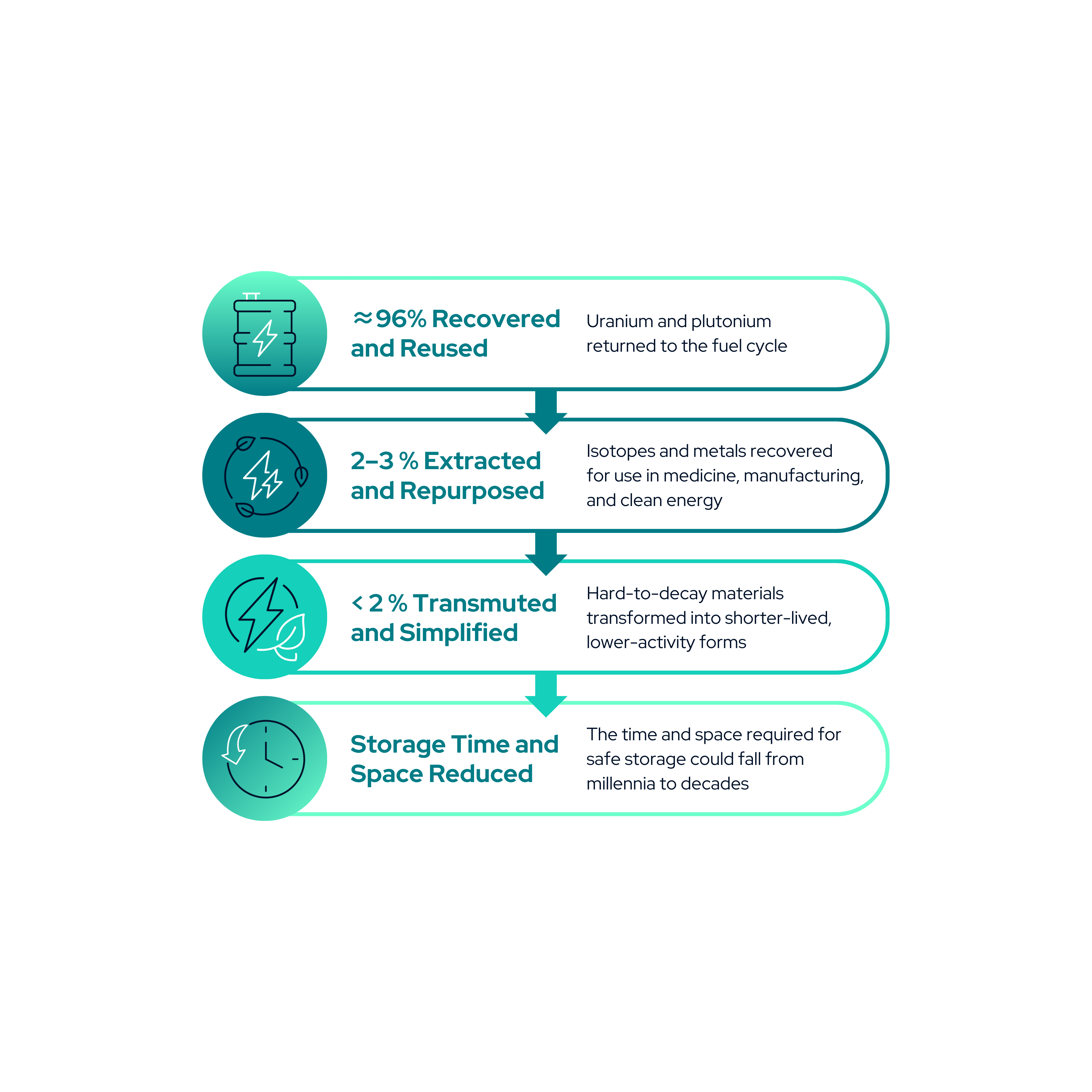
Projected outcomes of our recycling process now in development.
Our commercial operations already apply the technical rigor and regulatory discipline that nuclear fuel recycling requires. This foundation—built through years of licensed nuclear work—gives us a meaningful advantage in readiness and capability few others can claim.
Proven nuclear operations. At our medical-isotope facility, which is being NRC-licensed, in Janesville, Wisconsin, we plan to handle and separate radioactive materials. The same culture of safety and precision underpins our approach to used-fuel recycling.
Fusion and radiochemistry expertise. The core technologies that power our fusion-driven isotope production and neutron-testing programs are being adapted to recover reusable materials from used fuel. Building on our experience, we’re applying proven processes to advance the next generation of recycling capabilities.
Government-supported innovation. Through programs with the U.S. DOE and collaborations with national laboratories, we’re demonstrating and validating aqueous recycling methods to separate uranium and plutonium. We’re also developing techniques to recover isotopes (such as strontium-90 and americium-241) and to test fusion-neutron approaches that could stabilize what remains.
The strength of our used-fuel recycling program shows in the company we keep. From national laboratories to global industry leaders and next-generation energy firms, each collaboration reflects growing interest and confidence in our path forward.
We’re working with Argonne National Laboratory to demonstrate our aqueous extraction process on a lab scale and validate its performance for pilot deployment. Additional DOE funding through ARPA-E’s NEWTON program supports research into fusion-neutron methods to stabilize the remaining fraction of long-lived waste.
In collaboration with Orano, we’re adapting well-established recycling technologies to develop a proliferation-resistant process tailored for U.S. regulatory and commercial needs. The work helps lay the foundation for the nation’s first pilot-scale used-fuel recycling facility.
Beyond R&D, our relationships signal clear commercial potential. Collaborations with companies such as Zeno Power and Standard Nuclear highlight future demand for recycled isotopes and fuel feedstock—linking innovation today to the next generation of energy systems.
Each phase of our recycling program builds on licensed infrastructure—de-risked, regulated, and designed to scale as development milestones are achieved.
We’re conducting laboratory-scale demonstrations of aqueous separation processes with national lab partners. The ARPA-E NEWTON program supports our research into fusion-based transmutation. Pilot-site evaluations and early NRC pre-application engagement are underway.
Pending successful demonstrations and regulatory review, we plan to construct and operate a 100-metric-ton-per-year pilot facility to demonstrate commercial viability. This phase will validate process performance, confirm regulatory pathways, and assess economic readiness for wider deployment.
Building on pilot results, we intend to expand to regional recycling centers serving the growing nuclear fleet and to integrate fusion-driven transmutation modules that could further reduce long-lived waste.
SHINE is advancing practical solutions to one of nuclear energy’s most enduring challenges. Each breakthrough—recovering usable fuel, reclaiming valuable isotopes, and stabilizing what remains—builds toward a more sustainable nuclear future.
With proven experience, growing partnerships, and support from government and industry alike, we’re working to make used nuclear fuel recycling part of the foundation for clean, renewable energy.


